Abstract
This paper examines the purpose of a repeater’s rxdelay, txdelay and direct.txdelay parameters and their influence on collision probability within the MeshCore’s routing engine.
txdelay governs randomized retransmission timing for flood-based propagation, while direct.txdelay applies similar timing randomization to direct/unicast traffic. Both use the canonical backoff equation:
rxdelay has a similar random effect but only on reception.
We graph the timing windows to show how the txdelay and direct.txdelay parameters reduce simultaneous transmissions to reduce collisions and the retransmission of messages on a MeshCore mesh.
We propose a mechanism to automatically set repeater rxdelay, txdelay and direct.txdelay based on its local environment, using a count of the number of active/good signal strength neighbors within a single hop (0-hop, Direct) of a repeater.
1. Introduction
Flood-based mesh networks rely on randomized retransmission timing to prevent synchronized forwarding events. MeshCore exposes two timing parameters:
txdelay- controls randomization for flood routingdirect.txdelay- controls randomization for direct/unicast traffic
Both parameters reduce collision probability, but they operate in different traffic domains and must be tuned with different priorities.
2. Collision Dynamics in Mesh Networks
When multiple nodes receive or generate packets at nearly the same moment, they tend to transmit simultaneously unless randomized. Collisions occur when overlapping transmissions exceed the receiver’s capture threshold preventing reception of the message, resulting in it not being heard or received. MeshCore mitigates this through timing randomization applied separately to flood and direct transmissions and reception.
3. MeshCore Backoff Equations
MeshCore source code · MeshCore/examples/simple_repeater/MyMesh.cpp
// defaults
_prefs.airtime_factor = 1.0;              // one half
_prefs.rx_delay_base = 0.0f;              // turn off by default, was 10.0;
_prefs.tx_delay_factor = 0.5f;            // was 0.25f
_prefs.direct_tx_delay_factor = 0.2f;     // was zero

// equations
// The txdelay and direct.txdelay calculations for backoff are "identical"
// (same equations) but apply to different types of packets

uint32_t MyMesh::getRetransmitDelay(const mesh::Packet *packet) {
  uint32_t t = (_radio->getEstAirtimeFor(packet->path_len + packet->payload_len + 2) *
                _prefs.tx_delay_factor);
  return getRNG()->nextInt(0, 5*t + 1);
}

return (int)((pow(_prefs.rx_delay_base, 0.85f - score) - 1.0) * air_time);
The default value of txdelay is equal to 0.5 and the default value of direct.txdelay is equal to 0.2 (this is displayed as .1999999, not .2 since it is a float that is quantized for the displayed value).
The default value of rxdelay is equal to 0.
The Retransmit Delay (backoff) function in MeshCore is done in firmware and not done in hardware by the radio controller device. As txdelay is increased, the number of random “slots” increases, which decreases the probability of a collision (they are transmitted in different slots). A “slot” time is the calculated time of the transmission of the current message that’s ready to send.
It is important that these values be configured in online repeaters via a CLI command to something other than the default values in version 1.13.0 (ex CLI commands: set rxdelay 3, set txdelay 1.1 and set direct.txdelay .5).
- The default direct.txdelay sets packet transmission to immediate (no delay). This means there is a “guaranteed” collision.
- The default rxdelay sets packet reception delay to immediate (no delay). This can increase the probability of a collision.
- The default txdelay sets transmission to one of three transmission slots which has a 12.5% probability of collision if two nearby repeaters receive a Flood packet and both determine it needs to be transmitted. With additional neighbor repeaters, this results in a high to very high probability of a collision, which increases with additional neighbors retransmitting a Flood or Ack message.
Throughout the rest of this paper, when the term txdelay is used, it generally applies to both txdelay and direct.txdelay unless direct.txdelay is specifically stated.
3.1 Flood Backoff (txdelay)
Flood retransmission timing uses:
The retransmission delay is:
t defines the number of airtime-sized slots available for randomization.
This equation generates a random floating-point number and then converts it to an Integer (a counting number, no fractions) from between the lower bound (0) and upper bound (0, 5*t + 1) which gives a uniform distribution within a specified range. Every value between the lower bound and upper bound has an equal probability of being selected.
3.2 Interpretation of the 5× Multiplier
With a normalized airtime (default setting = 1.0):
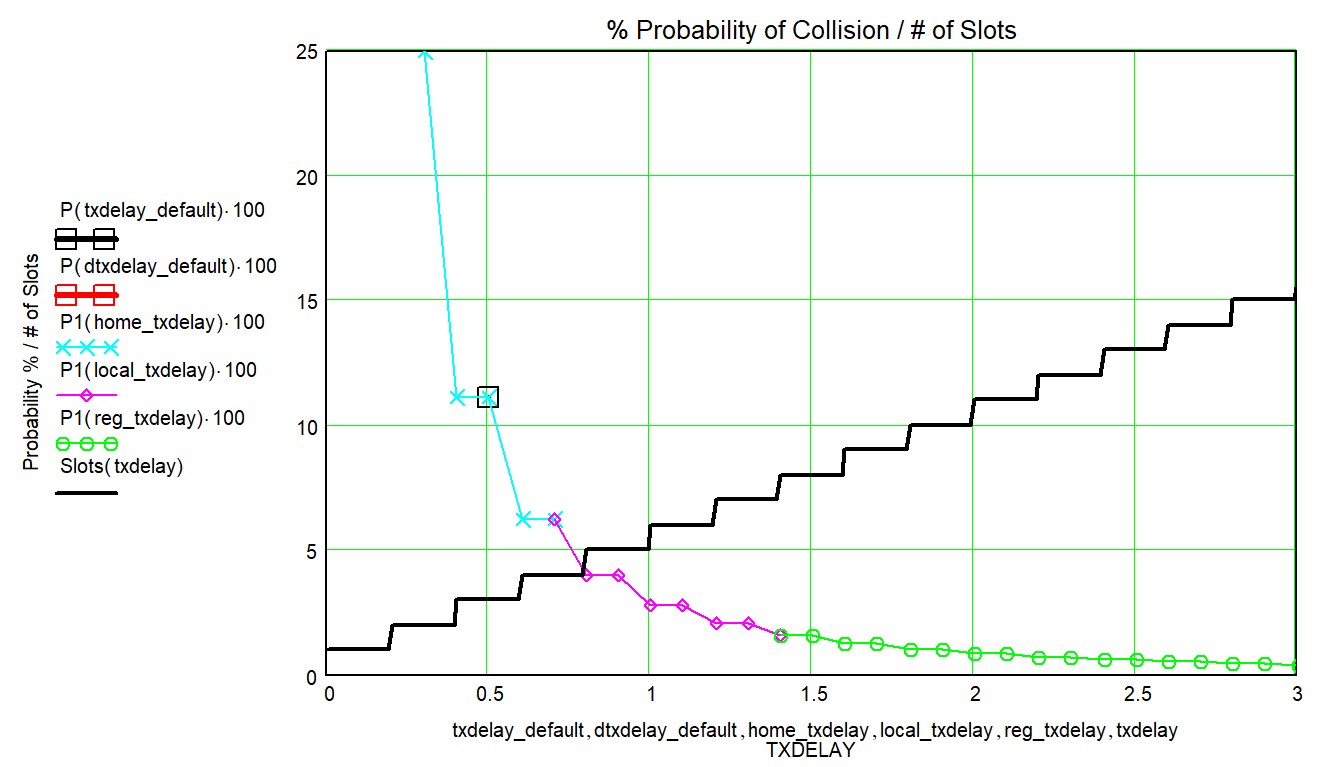
This creates discrete threshold “steps” (see Figure 2) where small changes in txdelay do not always create an additional transmit slot to reduce the probability of a collision.
3.3 Collision Probability as a Function of t
Collision probability decreases approximately with:
Caveats regarding the following figures:
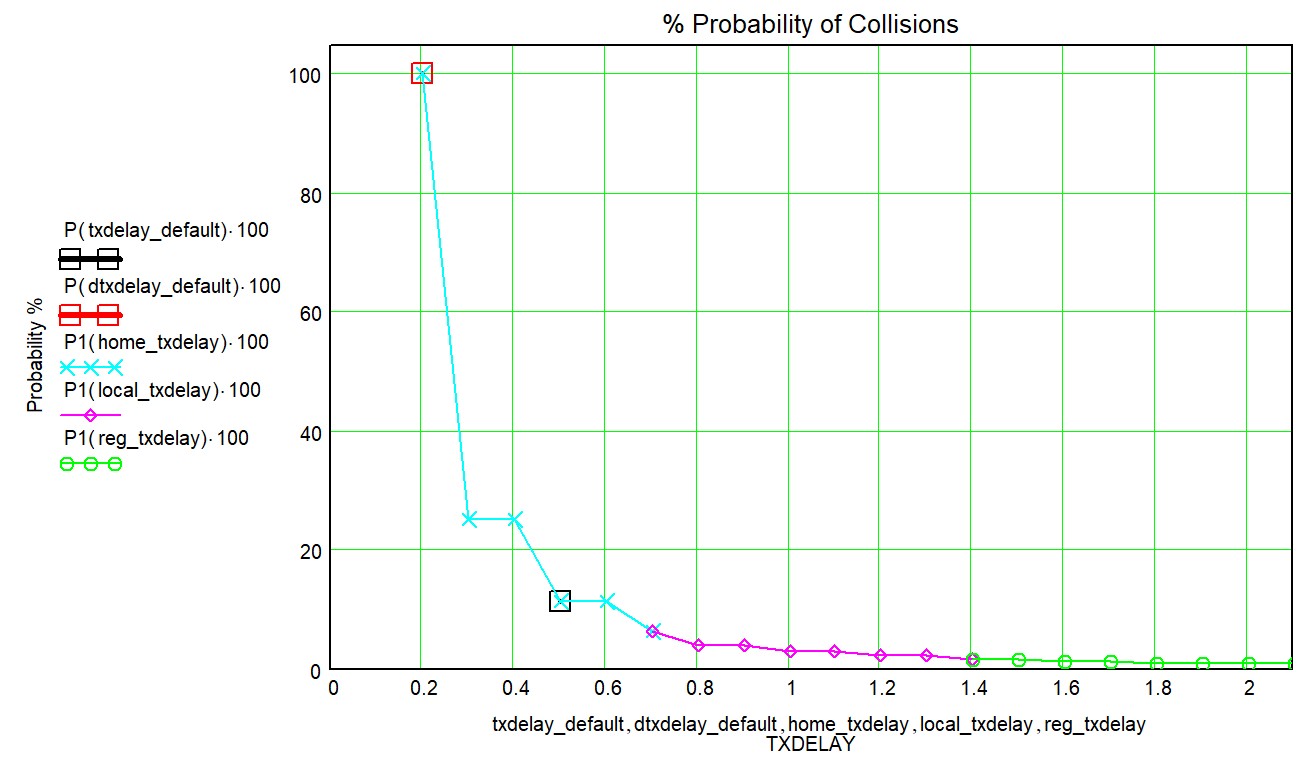
In the two graphs below txdelay (and implicitly direct.txdelay) were arbitrarily assigned as:
- Home repeater 0.3 to 0.7 (in steps of 0.1)
- Local repeater 0.7 to 1.4 (in steps of 0.1)
- Regional repeater 1.4 to 3.0 (in steps of 0.1)
This is not the proposed grouping; it was simply used to generate a segmented and colored graph. Please note that txdelay cannot be set above 2.0 via the CLI. The graph goes to 3.0 to show the trend. The following chart demonstrates the reduction in the % Probability of a Collision (with another device set at the same txdelay value) as txdelay increases.
This only shows the probability of two repeaters choosing the same slot. With multiple repeaters the probability of collision goes up since they all could be choosing the same slot. This is a major reason the number of neighbors is the key factor in setting the txdelay value. For example: if you have twice as many neighbors repeating the same message, the probability of a collision ~ doubles. This effect is not shown in the figures.
The following chart is a “zoomed in” version of Figure 1 and shows the increase in the # of Slots as txdelay increases.
3.4 Flood Timing Threshold Examples
3.4.1 Timing Slot Expansion as txdelay Increases
| txdelay | 0.2 | 0.5 | 1.0 | 2.0 |
|---|---|---|---|---|
| 5× | 1.0 | 2.5 | 5.0 | 10.0 |
| t | 1 | 2 | 5 | 10 |
Slots:
t=1     t=2         t=5                  t=10
[0]     [0][1]      [0][1][2][3][4]      [0][1][2][3][4][5][6][7][8][9]
Without randomization (t = 0):
┌───────────────┐
│ TX A          │
└───────────────┘
┌───────────────┐
│ TX B          │              → 100% overlap → collision
└───────────────┘
With randomization (t = 6):
┌───────────────┐
│ TX A          │
└───────────────┘
              ┌───────────────┐
              │ TX B          │           → partial overlap → survivable
              └───────────────┘
                          ┌───────────────┐
                          │ TX C          │            → no overlap → clean
                          └───────────────┘
3.4.2 Collision Behavior with Increasing txdelay
| txdelay | 5×txdelay | t | Collision behavior |
|---|---|---|---|
| 0.1 | 0.5 | 0 | Nearly guaranteed collisions |
| 0.5 | 2.5 | 2 | High collision rate |
| 1.0 | 5.0 | 5 | Stable in sparse meshes |
| 1.3 | 6.5 | 6 | Stable in medium meshes |
| 1.9 | 9.5 | 9 | Very stable |
| 2.0 | 10.0 | 10 | Extremely stable |
3.5 Direct Traffic Backoff (direct.txdelay)
While txdelay governs flood retransmissions, MeshCore applies a parallel but narrower randomization window to direct/unicast traffic via direct.txdelay.
3.5.1 Conceptual Role
- Prevents clumping when multiple nodes send direct packets at the same moment
- Reduces collisions in room-server, control, and interactive traffic
- Preserves responsiveness by keeping the window smaller than flood timing
3.5.2 Typical Pairing
| Flood (txdelay) | Direct (direct.txdelay) | Notes |
|---|---|---|
| 1.0–1.2 | 0.4–0.6 | Sparse meshes |
| 1.3–1.6 | 0.5–0.8 | Medium density |
| 1.8–2.1 | 0.6–0.9 | Dense / hilltop |
| 2.0–2.5 | 0.6–0.9 | Regional |
3.5.3 Why direct timing is smaller
- Direct traffic is latency-sensitive
- Direct transmissions involve fewer simultaneous senders (only 1 hop away)
- Flood traffic requires much wider desynchronization
3.6 Direct Packet Forwarding and Collision Characteristics
Direct (unicast) packets behave fundamentally differently from flood packets in MeshCore’s routing engine. While a flood packet is intentionally forwarded by every eligible repeater, a direct packet is forwarded by exactly one repeater per hop - the selected next-hop in the routing path.
3.6.1 Single-Forwarder Property
When a direct packet is transmitted:
- Multiple repeaters may receive it.
- Only the designated next-hop (as determined by the routing engine) will retransmit it.
- All other receivers will discard the packet after deduplication.
This “single-forwarder” behavior means that a direct packet does not fan out (goes from one to more than one) and therefore does not create the synchronized multi-node retransmission wavefront that flood packets do.
3.6.2 Implication for Collision Probability
Because only one repeater retransmits a given direct packet:
- The probability of collision for that packet’s retransmission is independent of direct.txdelay.
- There is no competition between multiple nodes forwarding the same direct packet.
- The backoff window for direct traffic does not influence whether that specific packet collides with another copy of itself - because no such copies exist.
- If a collision does occur, that packet is lost and an Ack is not sent and is not received by the sender. The retry mechanism of the sender will re-transmit the packet and hopefully will not collide again. If too many collisions occur packets cannot get through to the receiver or if they do, the Flood Ack cannot return, and the sender will see a message Fail.
3.6.3 Where direct.txdelay does matter
direct.txdelay is not designed to mitigate collisions between copies of the same packet. Instead, it reduces contention between independent direct transmissions, such as:
- Multiple nodes sending direct packets at similar times
- A single node with several direct packets queued close together
- Bidirectional or interactive traffic where both ends transmit concurrently
In these cases, randomized spacing helps prevent overlapping transmissions from unrelated direct flows.
3.7 Temporal Separation Through Tiered txdelay Values
MeshCore deployments should assign different txdelay values to repeaters based on their functional role or geographic reach. This creates tiered retransmission windows that naturally separates for example: local and regional transmissions in time, reducing cross-tier collision probability.
A local repeater configured with txdelay = 1 therefore selects a retransmission delay from:
A regional repeater configured with txdelay = 2 selects from:
3.7.1 Temporal Band Separation
Because the regional node’s window is strictly larger, the interval [5, 10] is exclusive to regional retransmissions. Any regional delay drawn from this upper band is guaranteed non-overlapping with all possible local retransmissions, which are confined to [0, 5].
This creates a natural temporal hierarchy:
- Local repeaters transmit earlier, occupying the lower portion of the backoff window.
- Regional repeaters transmit later, with access to a collision-free tail region unavailable to local nodes.
3.7.2 Operational Benefits
This tiered structure provides several advantages:
- Reduced cross-tier collisions: Regional retransmissions occurring in the upper half of their window cannot overlap with local retransmissions.
- Improved reliability for long-range propagation: Regional nodes act as a “second wave” of retransmission, reinforcing coverage after local nodes have already attempted delivery.
- Implicit prioritization: Local nodes provide fast, low-latency coverage; regional nodes provide slower but more robust reinforcement.
3.7.3 Limitations
The guarantee applies only to cross-tier interactions:
- Two regional nodes may still collide if both select delays within the same sub-interval.
- Two local nodes may collide if their delays differ by less than one airtime unit.
- The guarantee does not extend to unrelated direct traffic.
Nevertheless, tiered txdelay values provide a simple and effective mechanism for temporal separation between repeater classes, improving overall flood stability without requiring explicit coordination.
3.8 Receive-Window Randomization (rxdelay)
rxdelay introduces controlled entropy into the timing of receive-window openings to prevent deterministic synchronization across nodes. While txdelay is the primary mechanism for reducing transmit-side collisions, rxdelay provides secondary stabilization that prevents timing lockstep, ACK clustering, and hop-to-hop synchronization effects that txdelay alone cannot resolve.
3.8.1 Functional Role
After a node transmits or forwards a packet, it applies a randomized delay before opening its receive window:
This offsets the RX window relative to other nodes that heard the same transmission, ensuring that receive-window openings are statistically distributed rather than synchronized.
3.8.2 Interaction with txdelay
txdelay and rxdelay address different collision modes:
txdelayrandomizes when nodes transmit, directly reducing simultaneous airtime occupancy.rxdelayrandomizes when nodes listen, preventing synchronized receive windows, ACK storms, and deterministic hop-timing patterns.
Because collisions occur during transmission, txdelay has the dominant effect on collision probability. rxdelay prevents the mesh from falling into repeating timing patterns that txdelay alone cannot break.
3.8.3 Collision-Reduction Effect
The probability that two nodes open overlapping RX windows is approximately:
Once rxdelay exceeds roughly 3–4× the packet airtime, the marginal reduction in overlap probability becomes small. This is why rxdelay does not need to be large to be effective.
| rxdelay | Approx overlap probability | Interpretation |
|---|---|---|
| 2 | 50% | High overlap; only small meshes tolerate this |
| 3 | 33% | Good for medium meshes |
| 4 | 25% | Strong desynchronization; good general setting |
| 5 | 20% | Dense mesh protection |
| 6 | 17% | High-fan-out / hilltop stability |
3.8.4 Topology-Specific Recommendations
The following values assume typical LoRa airtime for MeshCore deployments and scale proportionally with modulation settings.
Sparse networks (0–3 nodes, low contention)
- rxdelay: 2–3 × airtime
- Rationale: Collisions are rare; rxdelay only needs to prevent occasional RX-window alignment.
- Notes: Latency should remain minimal; larger rxdelay provides no benefit.
Medium networks (4–8 nodes, moderate contention)
- rxdelay: 3–4 × airtime
- Rationale: This range provides sufficient desynchronization to prevent ACK overlap and hop-timing lockstep.
- Notes: This is the “default safe” operating region for most deployments.
Dense networks (9–10 nodes, high mutual visibility)
- rxdelay: 4–6 × airtime
- Rationale: Dense meshes experience more ACK clustering and receive-window overlap.
- Notes: rxdelay above 6× airtime yields diminishing returns unless the topology is highly symmetric.
Regional / hilltop / high-fan-out networks (repeaters hearing 11–12+ nodes)
- rxdelay: 6–8 × airtime
- Rationale: Hilltop repeaters receive bursts of packets from many nodes; RX-window desynchronization is critical to avoid ACK storms.
- Notes: Larger rxdelay increases latency but significantly improves stability in high-fan-out topologies.
3.8.5 Listen Before Talk (LBT) Backoff
LBT stands for Listen-Before-Talk, a common RF concept where a device must not transmit while the channel is busy. MeshCore does not implement formal LBT, but the radio hardware naturally behaves this way because it is half-duplex:
- A node cannot transmit if it is currently receiving a packet.
- If a scheduled transmission time arrives while the radio is receiving, the transmission is deferred until the receive operation finishes.
This creates an RX-Busy Deferral window.
RX-Busy Deferral (implicit LBT) - this forced delay behaves like an implicit, topology-dependent random backoff, since each repeater receives a different set of packets at different times. The result is additional timing decorrelation beyond txdelay and rxdelay, improving collision avoidance and preventing timing lockstep in dense or active meshes. This occurs before rxdelay processing occurs. It has been measured on a busy “Hub” repeater.
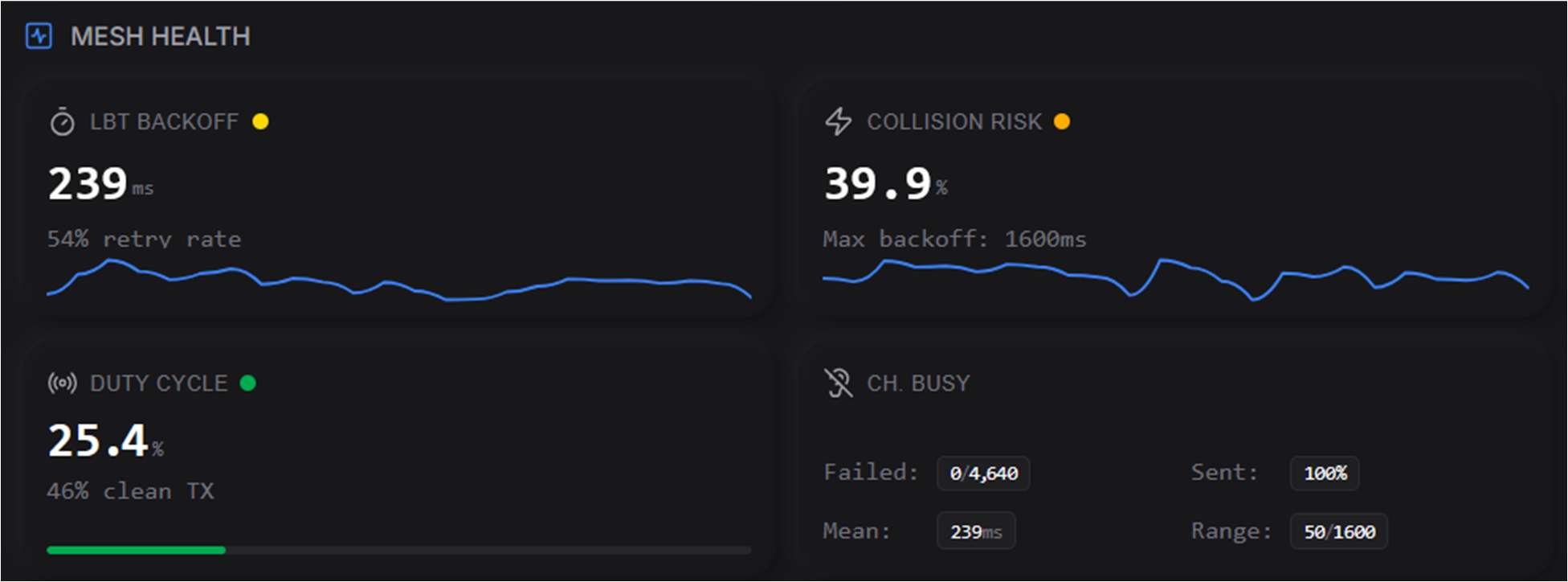
RX-busy deferral is only loosely and noisily correlated with neighbor count. It’s really a function of:
- who’s talking right now
- what paths the routing engine chose
- local noise and link asymmetry
- burstiness of traffic
So, while it does carry some congestion signal, it’s not a clean, monotonic “more neighbors → more RX-busy” metric you can safely tune against. It would also require significant effort to incorporate and measure in the Firmware. Given that:
- txdelay already handles the dominant collision space,
- rxdelay gives you controlled, topology-aware jitter, and
- RX-busy deferral is already helping implicitly,
We are not incorporating this into the algorithm.
3.8.6 Receive Delay Summary
rxdelay is a lightweight, secondary randomization mechanism that complements txdelay. While txdelay carries the primary responsibility for collision avoidance, rxdelay prevents synchronized receive behavior and timing lockstep, ensuring that the mesh remains statistically decorrelated over time. A modest rxdelay - typically 3–4 airtime windows - is sufficient for most environments, with larger values reserved for dense or high-fan-out topologies. LBT Backoff is not being considered.
4. Deployment Guidance
4.0 Density Classification Using SNR-Positive Neighbors
A good indicator of collision risk is the number of neighbors with SNR > 0. This excludes weak or marginal neighbors whose packets are less likely to be decoded and therefore do not meaningfully contribute to contention.
This produces four operational density classes:
| Density class | Neighbor count (SNR > 0) | Interpretation |
|---|---|---|
| Sparse | 0–3 | Few decodable neighbors; low concurrency |
| Medium | 4–8 | Typical suburban or rolling-terrain mesh |
| Dense / Hilltop | 9–10 | Tight urban clusters, or local elevated sites |
| Regional | 11, 12+ | High fan-out, elevated sites |
These thresholds are intentionally conservative and map directly to the recommended txdelay tiers.
4.1 Sparse Meshes (≤3 neighbors)
- txdelay = 1.0–1.2
- direct.txdelay = 0.4–0.6
- Produces t = 5–6 for flood, t_direct = 2–3 for direct
- Balanced latency and stability
4.2 Medium Density (4–8 neighbors)
- txdelay = 1.2–1.6
- direct.txdelay = 0.5–0.8
- Produces t = 6–8 and t_direct = 2–4
- Strong collision reduction
4.3 Dense / Hilltop (9–10 neighbors)
- txdelay = 1.8–2.1
- direct.txdelay = 0.6–0.9
- Produces t = 9–10+ and t_direct = 3–4
- Maximum desynchronization for flood while keeping direct traffic responsive
4.4 Regional / High-Fan-Out (11–12+ neighbors)
- txdelay = 1.8–2.5
- direct.txdelay = 0.6–0.9
- Produces t = 9–10+ and t_direct = 3–4
- Maximum desynchronization for flood while keeping direct traffic responsive
5. Operational Symptoms
5.1 Too-Low txdelay
- Bursty packet loss
- Identical timestamped retransmissions
- Route oscillation
5.2 Too-Low direct.txdelay
- Direct messages collide when multiple nodes talk to the same server
- Room traffic shows clumping in logs
5.3 Too-High Values
- Flood: increased end-to-end latency
- Direct: sluggish interactive traffic
6. Stale Neighbor Entries in a Repeater’s Neighbor List
There is one additional consideration that need to be addressed: the neighbor count should not include repeaters that are “stale”. Repeaters that haven’t been heard in some time, because they were moved, their ID changed, they have failed and were not replaced, etc.
- Including them in the neighbor count will unnecessarily skew them to a higher value
- They are no longer active in the neighborhood
6.1 When to Purge Stale Neighbor Entries in a Repeater’s Neighbor List
A repeater’s neighbor list should remain accurate, minimal, and self-cleaning to ensure stable routing and predictable RF behavior. MeshCore uses two independent staleness measurements - Zero-Hop Adverts and Flood Routed Adverts (which are received on the first hop) - to mark when they are “heard” and placed/updated in the neighbor table. Currently there is only a manual mechanism to purge a stale neighbor by viewing the neighbor table to determine which are stale and using the CLI command neighbor.remove (Hex ID) to delete them. If they are not removed, they will stay until the repeater is rebooted when the neighbor table is cleared and then subsequently rebuilt.
This section describes a mechanism that a repeater could use to purge invalid neighbor entries automatically, based on the advert-interval logic.
6.2 Stale Neighbors
Repeater neighbors are only direct, zero-hop neighbors. Because of this, their presence can be validated using Zero-Hop Adverts, or Flood Adverts (first hop). However, a detected repeater may only exist for a short period of time and then “disappear” and remain in the neighbor table. These stale entries should be purged and not included in the count.
- Flood Advert interval in hours
- Valid range: 3–168
- Default 12 hours
- Zero-Hop Advert interval in minutes
- Valid range: 60–240
- Default 0 (disabled)
- It is recommended that the default be changed to the maximum value (240 minutes = 4 hours)
- This does slightly increase local traffic, but because it is not forwarded (like Flood Adverts) the mesh airtime increase is very low, since it is local only
- This gives an earlier indication that a repeater is online.
6.3 Purge Criteria
A repeater neighbor is considered stale and should be purged if:
- No Advert (Zero-Hop or Flood) has been received since 2 × the maximum Flood advert interval. Which means if no advert is heard within 14 days then that repeater should be purged.
7. Coding Rate
Coding Rate (CR) in MeshCore is a LoRa physical-layer forward-error-correction (FEC) parameter. Although MeshCore defines routing, timing, and reliability semantics at higher layers, the LoRa radio
7.1 General Recommendations
- CR5 for general mesh traffic
- CR6–CR8 for impaired or long-range links
7.2 CR Selection by Repeater Class
- Sparse repeaters - Recommended CR: CR5 (CR6 if marginal). Low collision probability → minimize airtime.
- Medium repeaters - Recommended CR: CR5 or CR6. Balance airtime vs reliability.
- Dense repeaters - Recommended CR: CR5 only. Airtime dominates; higher CR increases collisions.
- Regional repeaters - Recommended CR: CR8. Long-range, low-SNR, mountain-top backbone links benefit from maximum parity.
CR8 is more airtime-efficient than CR5–CR7 because retries cost more airtime than a single CR8 transmission.
8. Conclusion
txdelay and direct.txdelay together form MeshCore’s timing randomization framework. txdelay governs flood retransmissions and is the dominant factor in collision mitigation, while direct.txdelay provides a lighter-weight desynchronization mechanism for direct/unicast traffic.
A txdelay or direct.txdelay value of 0.6 provides an ~6.25% probability of collision; greater values reduce this further. A collision forces a packet to be transmitted twice, increasing airtime consumption. The number of available slots - not airtime factor - is the primary determinant of collision probability:
- Fewer slots → more collisions
- More slots → fewer collisions
Increasing retransmit delay does not increase airtime consumption; it only delays the transmission. Avoiding collisions, however, reduces airtime consumption.
A good factor for selecting values for an individual repeater is the number of neighbors with SNR > 0. Raw neighbor count is misleading; low-SNR neighbors often fail to deliver usable packets and should not influence density classification.
9. Recommended MeshCore Code Changes
The following code modifications are recommended to improve routing stability, reduce collision probability, and ensure that repeaters dynamically adapt to real-world RF conditions. These changes formalize an architectural model in which Zero-Hop Adverts provide repeater-presence detection, while txdelay parameters adapt automatically to neighbor density.
9.1 Update Default Transmit Backoff Timing Parameters
9.1.1 Change txdelay Default to 1.1
This value provides a safe, low-latency baseline for flood-packet backoff. It reduces collision probability in typical deployments while remaining conservative enough for sparse networks.
9.1.2 Change direct.txdelay Default to 0.5
Directed packets do not fan out and therefore require a smaller backoff window. A default of 0.5 minimizes latency while preventing synchronized retransmissions.
9.1.3 Change rxdelay Default to 2
A modest rxdelay - typically 3–4 airtime windows - is sufficient for most environments. The Sparse setting was chosen as a beginning value that will be updated by the tuning algorithm.
9.2 Automation Sequence
- Run
Purge_Neighbors()first - Then run
Tune_Transmit_Delay()
9.3 Add Periodic Scrubbing of Stale Neighbor Entries
Neighbor tables must be periodically cleaned to remove stale or invalid entries.
9.3.1 Reasons for Scrubbing
- Repeaters may be replaced or reprogrammed, leaving orphaned IDs
- Failed repeaters may never return
- Weak neighbors may disappear permanently
- Stale entries distort neighbor-density calculations
- Incorrect density leads to incorrect txdelay tuning
9.3.2 Scrubbing Rules
A neighbor entry is removed if:
- It has not been heard from within 2 × the maximum Flood Advert Interval
- It has not been heard from in 16 days (failsafe)
9.3.3 Scrubbing Frequency
Run every other time a Flood Advert is sent. With the maximum transmit flood interval this would be every 14 days. This seems a reasonable schedule. It is possible that a “live” repeater might be purged due to a low SNR, collisions, lack of a path, etc. But it will be re-added when an Advert is eventually heard. The purging would be more frequent if an operator manually sets the interval to a lower value. Low SNR neighbors are not counted and may remain in the neighbor list.
This frequency is appropriate because neighbor density changes slowly and should not cause rapid oscillation in txdelay values.
9.3.4 Behavior After a Full Scrub or Initial Deployment
- If the neighbor list is cleared, the repeater resets to the default txdelay and direct.txdelay values
- As Zero-Hop and Flood Adverts arrive, the neighbor table rebuilds
- The tuning algorithm gradually adjusts (up or down) the values to the optimal range
- The system converges automatically without operator intervention
- This ensures stable behavior even after major topological changes.
9.4 Add Automatic Tuning Logic for Repeaters
Repeaters should dynamically adjust their txdelay and direct.txdelay values based on neighbor density, measured by the number of neighbors with SNR > 0.0.
This allows the system to adapt to:
- seasonal weather changes
- RF fading and multipath
- repeater failures
- new repeater installations
- intermittent weak-signal neighbors
- long-term topology drift
9.4.1 Algorithm Overview
Each repeater maintains a Neighbor Table which contains the existing values used to drive this algorithm (no additional information is required):
- Neighbor ID
- Last-heard timestamp
- Last-heard SNR
- Staleness state: Zero-Hop and Flood based (last heard)
9.4.2 Automatic Tuning Steps
1. Count neighbors with SNR > 0.0
- Filters out noise-floor ghosts
- Excludes intermittent or unusable links
- NOTE: A higher SNR threshold may be chosen to eliminate additional repeaters due to a low signal strength. Possibly for higher neighbor counts, use a more stringent criterion.
- A modified count may be appropriate for some Sparse topologies. If the repeater is classified as Sparse and some of its neighbors have a SNR < 0.0, then to compensate for the low SNR of those repeaters the CR should be increased to CR6 or CR7 to allow error correction on those low SNR repeaters (* see below). A simplifying alternative is to just use CR6 or CR7 and not modify the counting procedure (SNR > 0.0).
2. Use this count as an index into a tuning table. Example (illustrative):
| Density class | Neighbor count | txdelay | direct.txdelay | rxdelay | CR |
|---|---|---|---|---|---|
| Sparse | 0 | 1.0 | 0.4 | 2 | CR5 * |
| 1 | 1.1 | 0.5 | 2 | CR5 * | |
| 2 | 1.2 | 0.6 | 3 | CR5 * | |
| 3 | 1.2 | 0.6 | 3 | CR5 * | |
| Medium | 4 | 1.3 | 0.7 | 3 | CR6 |
| 5 | 1.4 | 0.7 | 3 | CR6 | |
| 6 | 1.5 | 0.7 | 4 | CR6 | |
| 7 | 1.6 | 0.8 | 4 | CR6 | |
| 8 | 1.7 | 0.8 | 4 | CR6 | |
| Dense | 9 | 1.8 | 0.8 | 5 | CR5 |
| 10 | 1.9 | 0.9 | 6 | CR5 | |
| Regional | 11 | 2.0 | 0.9 | 7 | CR8 |
| 12+ | 2.1–2.5 | 0.9 | 8 | CR8 |
3. Apply the new values
- Changes take effect immediately
- Values remain stable until the next scheduled automatic or manual evaluation
4. Repeaters automatically adapt
- As neighbors come and go
- As SNR fluctuates
- As RF conditions evolve
Summary:
- As Zero-Hop and Flood Adverts arrive, the neighbor table updates with possibly new neighbors
- The Scrubbing mechanism removes stale neighbor repeaters
- The tuning algorithm gradually raises or lowers the rxdelay, txdelay and direct.txdelay values to the optimal range for the current neighbor count
- The system converges automatically without operator intervention
This ensures stable behavior even after major topological changes and initial deployment.
Next Steps: Obtain feedback to improve this proposed algorithm or utilize a different approach. Once consensus is reached, implement this into the main MeshCore firmware stack. One specific request is to review the groupings and values associated to verify their appropriateness. The algorithm appears to be sound.